
Product details
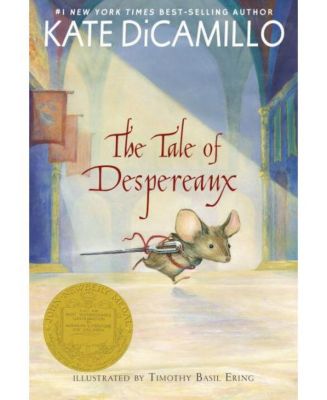
Web ID: 14352517A brave mouse, a covetous rat, a wishful serving girl, and a princess named Pea come together in Kate DiCamillo's Newbery Medal winning tale. Welcome to the story of Despereaux Tilling, a mouse who is in love with music, stories, and a princess named Pea. It is also the story of a rat called Roscuro, who lives in the darkness and covets a world filled with light. And it is the story of Miggery Sow, a slow-witted serving girl who harbors a simple, impossible wish. These three characters are about to embark on a journey that will lead them down into a horrible dungeon, up into a glittering castle, and, ultimately, into each other's lives. What happens then? As Kate DiCamillo would say: Reader, it is your destiny to find out. With black-and-white illustrations and a refreshed cover by Timothy Basil Ering.
Product Features
- Author - Kate DiCamillo
- Publisher - Candlewick Press
- Publication Date - 12-08-2015
- Page Count - 272
- Paperback
- Age Range - 9-12 Years
- Juv Young Readers
- Product Dimensions - 5.1 H x 7.6 W x 0.9 D
- ISBN-13 - 9780763680893
Shipping & Returns
Tropy ,incongruous themes, contradictory world
"The Tale of Despereaux" should be a whimsical story of cute animals, bravery, and imagination perfect for children. "Despereaux" seems unable to strike this chord and instead gets weird and disjointed very quickly. The writing itself is mostly solid but for two things which are unforgivably annoying. First is what I call the “Dear reader” trope where comments like “And then, reader…” or “But, reader, he did look,” litter the story. I imagine this is supposed to feel more personal, as though the author is actually telling the story, and while it can work in select circumstances, I find it usually ruins immersion in the story. While “Dear reader” comments tend to come across as condescending, this problem is made even worse here by the forced inclusion of big words. To be clear, I favor large vocabularies, and the inclusion of uncommon words is not necessarily bad, but to use one and then address the reader directly to bring attention to the word, telling them to look it up in a dictionary (because clearly they are too young to know what it means) smacks of the condescension I so hate. The characters in this novel are flat, sticking with their assigned personalities without any development. Despereaux is the exception, though only mildly so. Worse, one particular character begins as a stereotypical bad guy, goes through a minor arc only to end up back where he started for no logical reason except that he is the species the author decided were the villains. The plot is even worse, spending most of its time catching back up to itself. The story is split between three main characters, each of them getting a separate portion, while the fourth section unites them all and resolves the story. The first part sets the story in motion with a focus on Despereaux while parts two and three provide backstory on two other characters. Backstory can be beneficial, but the execution and length of these sections brought the book’s momentum to a grinding halt, so much so that when the final section of the book begins, it cannot build enough momentum to carry the climax. The world of this book is generic at best and is also beset with myriad inconsistencies which degrade the believability of the story’s setting. For example, it takes place in a kingdom where slavery is illegal, but the king has a dungeon with no light where people are sent to die. And the king is supposed to be one of the good guys. There are several other inconsistencies I cannot reference because this is a spoiler free review. Suffice it to say, the world and characters generally do not make much sense which absolutely demolishes the coherence of the story. More than anything else, what ruins this book is the weird thematic elements. The big one is that a mouse falls in love with a human. There is the typical argument that love at first sight is unrealistic and should not be normalized, but beyond this, the very idea is pretty disturbing considering the target age demographic. Albeit nothing comes of this love because “Even in a world as strange as this one, a mouse and a princess cannot marry,” but even entertaining the concept in this roundabout way is a little creepy. And considering this story could easily have happened with the mouse and princess simply being friends, it makes me wonder what message this theme is supposed to be sending. "Despereaux" should have been a fun, whimsical book but a plethora of small and large problems force me to conclude it is not worth reading, especially for the target age range.
Customer review from barnesandnoble.com