
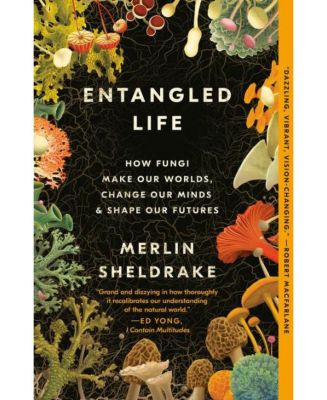
Barnes & NobleEntangled Life: How Fungi Make Our Worlds, Change Our Minds & Shape Our Futures by Merlin Sheldrake
$20.00
Low Stock
Product details
Web ID: 126206384 reviewssorted by Newest
B&N Mark R
1 year agofrom B&N Home Office
You'll never look at mushrooms the same way..
I certainly gained a new appreciation for fungi after reading this. I've known that they're vital to the world's ecosystem, but reading about the depth and breadth of their importance really put things in perspective. The oyster mushroom that could grow out of used cigarette butts, and the company working on creating furniture and even housing materials were highlights for me.
Recommends this product
Customer review from barnesandnoble.com
How fungi make our worlds
1 year agofrom Bangladesh
Entangled life
I bought 2 month ago and am happy to reading this bookRed Tower Books are so amazing its was really very awesome stroy ami i achoeved some knowledge
Recommends this product
Customer review from barnesandnoble.com
Crimson Alex
5 years agoGreat read!
This book helped to highlight many different aspects of fungi that are unique and it does include several tidbits about recent research into the area of the ability of fungi to grow in some insane conditions and with some nonconventional food sources. There are several passages that I highlighted to use in my classroom because they were very insightful and surprising. Another reviewer on a different site claimed that there is a lot of repetition and while that is true, I think that was intentional and i have no problem with an author circling back to something they said previously as it helps to tie things in. I hope this author writes some more books in the future as this one was a gem!
Customer review from barnesandnoble.com
My notes
Below are my notes for Littler Books. I hope you find them helpful! 1. Fungi communicate and manipulate other organisms through chemical signals, especially scent. a. Truffles are underground fruiting bodies of fungi that cannot disperse their spores by air. They solve this problem by producing scents that lure animals to dig them up and eat them, thereby spreading their spores. 2. Mycelium is the vegetative/reproductive part of a fungus, made up of a network of fine white filaments called hyphae. 3. Mycelium is a decentralized network that can navigate complex environments without a central control system. a. "Mycelium is a body without a body plan." b. Experiments showed that a wood-rotting fungus was able to find the most efficient path between blocks of wood. 4. Mycelial networks can coordinate their behavior over large distances using a fast communication system, likely based on electrical impulses. 5. "A mycelial network is a map of a fungus's recent history and is a helpful reminder that all life-forms are in fact processes not things. The 'you' of five years ago was made from different stuff than the 'you' of today. Nature is an event that never stops. As William Bateson, who coined the word genetics, observed, 'We commonly think of animals and plants as matter, but they are really systems through which matter is continually passing.'" 6. Lichens are composite organisms formed by a partnership between fungi and algae or bacteria. Symbiosis describes the partnership between organisms. a. The symbiotic nature of lichens allows them to survive in extreme environments (e.g., space, radiation, extreme temperatures). b. "There have never been individuals … We are all lichens." 7. Some fungi have evolved to manipulate animals to ensure their own reproduction. a. The "zombie fungus" Ophiocordyceps unilateralis infects carpenter ants. It makes them abandon their nests, climb up plants, and clamp their jaws before dying, allowing the fungus to fruit and spread to other ants from the ant's head. b. This is not mind control, but achieved with chemicals that control the ant's muscles. 8. "Magic mushrooms" contain psilocybin that alters human consciousness. a. Psilocybin stimulates serotonin receptors in the brain, which reduces activity in the brain's default mode network (DMN) -- the part associated with ego and self-reflection. This leads to the dissolution of the sense of self. b. Clinical trials have shown that a single dose of psilocybin can cause lasting reductions in severe depression and anxiety, particularly in terminally ill patients. c. "Psilocybin appears to take effect not by pushing a set of biochemical buttons but by opening patients' minds to new ways of thinking about their lives and behaviors." d. Psilocybin likely evolved as a chemical defense against insects. e. Gordon Wasson's 1957 article, "Seeking the Magic Mushroom", popularized magic mushrooms. 9. In a mycorrhizal relationship, plants share sugars from photosynthesis with fungi, which return water and minerals. More than 90% of plant species today still depend on these relationships. a. This relationship works like a market. Plants can reward more cooperative fungal partners, while fungi can move resources around their network to "sell high" where nutrients are scarce. 10. When the algal ancestors of plants first moved onto land around 500 million years ago, they had no roots to extract nutrients from the rocky terrain. Mycorrhizal fungi acted as their root systems for tens of millions of years. 11. The boom in plant life decreased atmospheric carbon dioxide by 90% and triggered a period of global cooling. 12. Practices like tilling and the heavy use of chemical fertilizers and fungicides reduce the abundance and diversity of mycorrhizal fungi in the soil. This disruption makes crops more dependent on chemicals and more vulnerable to drought and disease. 13. Mycorrhizal fungi create vast, shared underground networks called wood wide webs that physically connect plants, sometimes of different species. These networks act as channels to transfer resources and information between plants. a. Carbon, nitrogen, phosphorus, and water can move through fungal networks, typically flowing from plants with abundant resources to those with fewer. b. The networks can also transmit warning signals. Experiments showed that when one plant was attacked by insects, its neighbors connected by the network activated their own chemical defenses, even without direct contact with the insects. 14. For millions of years during the Carboniferous period, wood did not decompose because fungi had not yet evolved the ability to break down lignin. This un-rotted plant matter became coal. Fungi are now master decomposers. 15. Fungi can help solve environmental problems: a. Mycoremediation is the use of fungi to break down pollutants. Fungi can degrade crude oil, pesticides, explosives, and plastics. b. Mycofabrication uses mycelium as a raw material to grow sustainable products like packaging to replace plastic, textiles to replace leather, and building materials to replace concrete. c. Researcher and entrepreneur Paul Stamets has shown that extracts from certain wood-rotting fungi can dramatically reduce the levels of deadly viruses in honeybees, offering a potential tool to combat colony collapse disorder. 16. The domestication of yeast for baking and brewing was a key factor in the Neolithic transition, when humans shifted from nomadic lifestyles to settled agriculture. a. "In many ways, you might argue, yeasts have domesticated us." 17. The drunken monkey hypothesis suggests humans like alcohol because our primate ancestors used its scent to find ripe fruit. 18. For centuries fungi were mistakenly classified as strange plants. Today, defining a fungal species is still difficult due to their variable forms. 19. We should embrace fungi's otherness and appreciate how they blur the lines between the individual and the ecosystem.
Customer review from barnesandnoble.com