
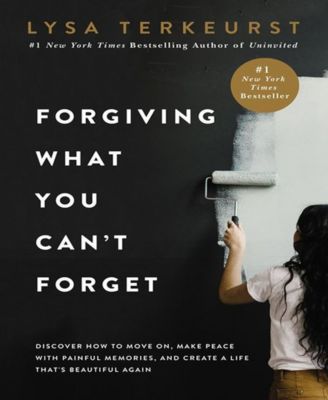
Barnes & NobleForgiving What You Can't Forget- Discover How to Move On, Make Peace with Painful Memories, and Create a Life That's Beautiful Again by Lysa TerKeurst
Product details
Web ID: 16835745Forgiving What You Can't Forget
A very well meaning friend sent me this book to read, knowing that I have been dealing with some issues. I found this book to be insightful and helpful in a few ways. There are practical tips, as well as many Bible verses, to bring a new perspective on forgiveness. The author is writing from personal experiences she's been through and giving practical advice from those situations. She's not a licensed counselor but I found the information to be helpful. This is a book that I'll keep handy and will probably read again at some point. I'm not one to write in books but I do think I'll be taking notes and highlighting areas when I read this again.
Recommends this product
Customer review from barnesandnoble.com
Books Pick You, You Don’t Pick The Books
This is a biblical principle based book from a Proverb 31 woman with bible scriptures* I enjoyed this book so much. I've been having this book for a few years and finally decided to read it. Very insightful and helpful considering how the world is and the people inside it. Not to mention, allowing the Holy Spirit to prick you and remind you that you have not arrived and in some areas "There's still work to do." Chapter 7 stuck out to me: A person who personalized everything, they immediately filtered it through unresolved pain, and unhealed hurts, from experiences they've had in their life story. They don't forget what was said to them, they're always building a case to support their perceptions. They quickly assign wrong motives and negative interpretations to what is done and said to them. I want to call it self help but not really .. the book aligned with scriptures and if you pray before reading it, I'm sure God will reveal somethings in this book in regards to you as well as to others. The book ministered to my spirit and the season that I am currently in. Forgiveness releases our need for retaliation, not our need for boundaries Bitterness is in part unprocessed grief Peace is an evidence of a life of forgiveness Undealt with pain and a mind at peace cannot coexist Forgiveness is suppose to be as much a part of our daily lives as eating and sleeping Some of the practical examples Lysa displayed were some hard truths that I had to go back and do some soul searching and look in the mirror. Remember: Books pick us, we do not pick the book, so if your spirit is drawing you this more than likely you're right where God has you :) 5/5 🌟
Recommends this product
Customer review from barnesandnoble.com
great book!!
i bought this book a month ago, i’m not much of a reader but this was an easy understandable book for me to read and i really loved the book. i would definitely read one of her other books :)
Recommends this product
Customer review from barnesandnoble.com
Enjoyable Read
This book is an enjoyable read, and the author speaks from her own pain, rather than just being educated and giving advice. I like that she states several times in the book that she struggles with taking her own advice, because there's nothing worse than an author who writes as if their advice should be easily done, because it gives you a feeling that they just don't understand how hard it is to do. Very good writing style, but in the end it's a "you must forgive others as God as forgiven you" book. It was helpful, but not life changing.
Recommends this product
Customer review from barnesandnoble.com
TerKeurst gives voice to pain & hope to healing
As usual Lysa TerKeurst puts beautiful words to our pain and gives hope to our healing yet again in this book. In fact, her story and her writing captivated me so much that I flew through the book. I didn't realize until the second to last chapter that I hadn't highlighted or bookmarked or taken notes. I will have to revisit so many portions of this book. I just kept a constant rally cry of, "Yes, that's me" "That's exactly how it feels" and "Thank God there is hope in this pain."
Recommends this product
Customer review from barnesandnoble.com
Forgiveness for healing!
I was honored to participate in a focus group in 2019 for this book. I read much of the material in process and if you have ever struggled with forgiveness of any kind - hurt from marriage, physical or emotional abuse, lies, family members other than spouses, other "church" folks, any kind of hurt at all. This book will help you work through that hurt so you can heal and have JOY again. God wants us to live joyful lives and you can, it is possible.
Recommends this product
Customer review from barnesandnoble.com
My book notes
Below are my notes for Littler Books. I hope you find them helpful! 1. Unforgiveness further hurts the victim. Results of unforgiveness, such as cynicism, bitterness, and resentment, disguise themselves as protections but actually lead to isolation and pain. 2. Forgiveness is not a result of determination but of cooperation with God. 3. Redemption is different from reconciliation. One can forgive and experience redemption even if the relationship is not restored. Redemption involves giving up the right to demand payment from the offender and receiving the freedom to move on. 4. People hesitate to forgive because they fear the offense will be repeated, feel the pain has not been validated, or believe forgiveness minimizes the hurt. Coping mechanisms like hyperspiritualizing or denying pain keep people stuck in their trauma. 5. Forgiveness can feel impossible or like a cruel command, but it is God's mercy for hate. Forgiveness is not dependent on the offender's apology, but is a way to exchange resentment for freedom. 6. If healing and forgiveness are not addressed, your pain often projects outward. Unresolved pain often turns into pain inflicted on others. 7. Healing requires deciding that the person who hurt you does not get to determine your healing. 8. By looking for hope rather than trying to rewrite the past, you can change your perspective and reality. a. “What we look for is what we will see. What we see determines our perspective. And our perspective becomes our reality.” 9. Just as Jesus healed the man at the pool of Bethesda without others, personal healing cannot be conditional on the offender's actions or the situation becoming fair. Your ability to heal cannot depend on them wanting your forgiveness but only on your willingness to give it. 10. Forgiveness is both a decision and a process. Understand that emotions and triggers will need to be managed over time. 11. When feelings do not align with the desire to forgive, rely on God. a. "And whatever my feelings don’t yet allow for, the blood of Jesus will surely cover." 12. Childhood experiences create scripts for navigating life. 13. To heal, you must revisit the stories and belief systems formed in the past that influence your current reactions and your struggles with trust and forgiveness. a. “Those things that happen in our lives don’t just tell a story. They inform us of the story we tell ourselves. If we listen carefully, woven throughout our narratives is a belief system that formed inside of us as children.” 14. Our past perceptions become present truths. Connecting past experiences and current behaviors is essential for healing. 15. Vulnerability is essential for intimacy and healing. Vulnerability is not exposing oneself to harm but opening up to know and to be known. 16. God can help with painful losses. a. “I have held many things in my hands, and I have lost them all; but whatever I have placed in God’s hands, that I still possess.” - Martin Luther 17. Just as miners used canaries to detect toxic gas, individuals must sniff out damaging thoughts that distort reality. Unchecked inaccurate perceptions lead to taking others' actions personally and misinterpreting events through the lens of past pain. 18. Shifting to a healthier perspective involves a three-step process: a. Collecting: Acknowledging the pain. b. Connecting: Accepting the past cannot change. c. Correcting: Choosing new, healthy perspectives. 19. Holding onto evidence of how one was wronged keeps the victim trapped in the past. a. “The proof doesn’t serve you; building a case won’t heal you. Holding on to all the hurt will only steal from you all that’s beautiful and possible for you. Let it go. Entrust it to God. He knows what happened and will address it all in equal measures of mercy and justice.” 20. Trauma can lead to a lifestyle of assuming worst-case scenarios, making it difficult to feel safe or hopeful. 21. Forgiveness is necessary even when situations remain unchangeable. 22. “Forgiveness is more satisfying than revenge.” 23. Because you cannot control another person, you need to draw boundaries to protect your own sanity and stability. 24. Working harder on someone else's problems than they are, or shielding them from consequences, is enabling, and it will perpetuate dysfunction. Boundaries shift the focus from control to compassion. This prevents you from becoming a casualty of other people’s actions. 25. When prayers seem unanswered, it is easy to question God. Lack of evidence does not mean God is inactive. He often performs slow miracles that are not immediately seen. a. “What makes faith fall apart isn’t doubt. It’s becoming too certain of the wrong things.” b. “God does some of His best work in the unseen.” 26. True hope is not just a wish for physical outcomes but an assurance of ultimate redemption. 27. Bitterness is often unprocessed grief. a. “Bitterness wears the disguises of other chaotic emotions that are harder to attribute to the original source of hurt.” b. “Bitterness doesn’t have a core of hate but rather a core of hurt.” 28. Hard hearts need to be softened by allowing grief to be processed. Tending to the grief of others can help process one's own loss. 29. “Humanity without humility makes true forgiveness impossible.” 30. Living peaceably is a personal responsibility. Peace is not the absence of conflict but an atmosphere one brings. Peace is the evidence of a life of forgiveness. 31. Forgiveness is a daily practice, not a one-time event. a. Jesus included forgiveness in the Lord's Prayer to show it is as essential as daily bread. 32. “The best time to forgive is before we are ever offended. The next best time to forgive is right now.” 33. Progress is better than perfection. Focus on making one better choice at a time rather than expecting immediate perfection. 34. “Maturity isn’t the absence of hard stuff. Maturity is the evidence that a person allowed the hard stuff to work for them rather than against them.”
Customer review from barnesandnoble.com