
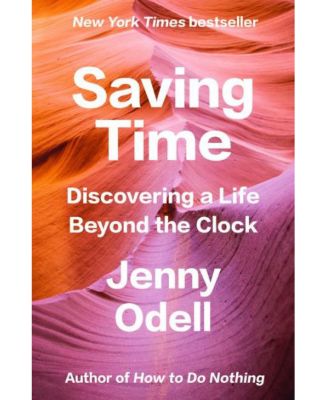
Barnes & NobleSaving Time - Discovering a Life Beyond the Clock by Jenny Odell
Product details
Web ID: 16490940Highly Recommend
I really appreciate this book; I got so much out of it, and I would definitely recommend it. I might even like it more than How to Do Nothing. I do wish that I'd thought about the fact that I'd probably other to read this as an audiobook; it took me a while to get through this as-is, but still, it was definitely engaging. I'm going to be thinking about this book for a long time. Thank you to Netgalley and Random House for the chance to read and review this ARC.
Recommends this product
Customer review from barnesandnoble.com
A thoughtful exploration of time
A thoughtful exploration of time, different conceptualizations of it, and how we can use it. Full of research and the author’s reflections, it is a provocative read that poses many questions that do not have easy solutions. I would have liked more focus on time as a commodity and who gets the privilege of more (“leisure”) time and recommendations for more time equity. This is dense and not easily accessible (somewhere between academic and reader-friendly but closer to the academic). I would recommend it to anyone looking for an intellectual and philosophical read. Thank you to Random House and NetGalley for the opportunity to read an advance copy.
Recommends this product
Customer review from barnesandnoble.com
Challenging Our Perceptions of Time (and Work)
Big thanks to Random House and Netgalley for sharing this advanced copy of Jenny Odell’s revolutionary book Saving Time: Discovering a Life Beyond the Clock. While I acknowledge that the COVID pandemic and social distancing were truly awful experiences where we regularly witnessed illness and death in an unprecedented scale daily and were sometimes subject to horrid hording behaviors stoked by fears of access to daily products and goods as well as the uncertainty of the time, there were some elements of social distancing that I really enjoyed and appreciated. I really appreciated being able to spend more time with my children, who were 6 and 3 at the time. While working days and nights, I was often missing from school drop-offs and bedtimes and all the playtime in between. Weekends were often spent on other chores and taking the kids to various activities, so we also didn’t have much time to go to parks or take hikes around our neighborhood like we did when my kids were infants and toddlers. However, the social distancing (plus the need to get my kids out of the house) allowed a kind of slowing down where we were able to take trips to state parks around our area and explore creeks and other forested areas nearby. My kids got so used to visiting a creek in walking distance to our house that they named a snake they discovered and looked for it each time we visited the creek, sometimes more than once a day. Jenny Odell’s book starts off with a kind of similar observation about time during the pandemic and how the near stoppage of work time (or its disruption) allowed her to focus on natural developments and growth near her home. I could immediately relate to Odell’s observations, although I didn’t have plants or cacti in my house, I remember how my kids and I charted time and change at the creek, noting different ducks and how the plants flowered during the springtime. I also ended up spending more and more time in my home office, working from home in a converted attic room. This was always my space in the house—I moved most of my books and my record collection along with my stereo and record player to this room. However, when I was able to work in the office, I loved revisiting my records, especially some of the classical albums I neglected. I also loved the view and breeze that arrived from the 3rd floor in April and May. There was a tree nearby, and the room was filled with different birdsongs. While I don’t necessarily want to revisit the pandemic lockdown, I do appreciate that it allowed me some time to slow down, spend more time with family, and really closely analyze the growth and development, the changes happening around me. When I initially requested this book for review, I was kind of expecting something of a self-help or primer about adjusting work habits or developing more self-care. I wasn’t expecting the kind of clarion call and critical analysis that Odell engages her readers. However, I was so appreciative of her stance in challenging popular notions about the hustle culture that pervades our economy and current times. Nevertheless, I needed to readjust my mindset to consider the critical approach and close analysis that Odell engages in throughout the book. I was not really familiar with Odell’s artwork, but from her writing, I can tell that she draws from a wide range of disciplines as each chapter regularly cites biology, sociology, economics, art, and psychology, among other disciplines. One of the more powerful chapters frames its analysis in disability studies, examining how our kind of western economic conceptions of time often fail to be inclusive and do not consider the experiences of those with physical or cognitive differences. Odell cites a parent and disability studies scholar whose experience raising a son with a disability challenged her conceptions of time and education, and helped her realize that learning is and can be an enjoyable experience that lacks the kind of stress or pressure to train and develop skills to be employable. Rather, she saw the joy and engagement that her son experienced in working with others and recognized that this was important. There were many other powerful experiences that Odell cites about people who maybe live outside of the clock—I’m struggling to come up with a term since she regularly cited the condescending and colonial-imperialist idea about indigenous people living “outside of time”, when really there concepts of time were not market driven. It was both enlightening and sad to learn that others like Native Americans and African Americans were often subject to a new concept of time, and frequently criticized when they failed to readjust their ideas and concepts of time to servile duties, and that these characterizations have often persisted despite being thrust upon these groups. Odell makes convincing arguments using the experiences of these marginalized groups why we should reconsider our conceptions of time, often slowing down or taking more time to explore the world on our own. Not only does her argument include being more inclusive, but she is also critical of the kind of hustler-striver culture that social media reinforces. The early chapters that are critical of this kind of concept of time that requires workers (and influencers) to always be on and reachable by email or other methods reminded me of some of Jia Tolentino’s criticisms in Trick Mirror, especially in the chapter that deals with the ideal woman. In fact, Odell thanks Tolentino in the acknowledgement section in the end, and their valid criticisms of how both technology and social media have disrupted our sense of time (and ourselves) are in synch. Odell, like Tolentino, sees that we often get less from social media than it takes from us, and for Odell, this means we lose more than just our time; we lose more of our ability to look closely at the world around us. It alters our perceptions and many times our enjoyment of the world. It almost seems like social media warps our sense of the world around us, and we frequently will look to objects, experiences, and people around us as to what will drive more engagement and clicks on our posts. Odell presents important ideas and reconsiderations of time throughout the book, but this one of the more interesting and topical arguments she makes. Odell intersperses her arguments with personal narrative and images she has collected. It seems like each narrative focuses on a journey she’s taken somewhere around the bay area, where she lives. In one chapter, it looks like she is outside the Meta campus, exploring the natural area around, but also recognizing how the buildings and development of Silicon Valley have altered the natural beauty of the environment. In another chapter, she describes a shipyard and the vast shipping containers that both contain many of the items we depend on for our lives on a daily basis, but also serve as impediments to the fauna around the port of the bay area. It was interesting to see how these animals have somewhat adapted to the presence of all of these large metal containers. The last chapter has her in a Columbarium, which I found out was a building that holds the urns of the cremated. I loved how this was the last section, and it sounded like a really interesting concept—that the urns were often shaped like books that would never open. It seemed like a kind of memento mori, but also an idea about the ways that our concepts of time have been set for us from birth (at least if we are born in western capitalistic systems). Yet living within this system for all of our life, it really doesn’t seem to matter much in the end. Odell’s book has really challenged the way I think about time, not only how I spend my time, but also what I value in my life and what I value for my children’s time. There’s been other instances of Odell’s arguments about time—especially thinking about Cathy Davidson’s “Project Classroom Makeover”, and how US schools have largely have operated under the same system for the past 120 years (if not longer). Much of our education system is based on the factory model, and reminding us of why we have separate classes and bells to signal when to be in what place. Schools operate under these behavioristic principles to train students to be workers, not really thinkers. It’s great that Odell, as an interdisciplinary artist, is able to take these fragments and pieces from so many different sources and bring them together to challenge this dominant way of thinking. I can tell that she is a teacher, beyond her references to her classes and the challenges of assessing art work, Odell uses the stories and examples from different disciplines to not only highlight elements of her argument, but also to appeal to different groups of people, helping them recognize the broader application of this challenge to economic time keeping. I also loved that she referenced the two different types of time in Greek—the Chronos and the Kairos. She uses these two words to emphasize the difference in considering time and to make the argument that we’ve gotten too far away from the Kairos, the consideration of the right time or the critical moment for action and are too focused on the chronological concept of time as a sequential unfolding of experiences. Although I recognize that this book may be challenging and somewhat controversial to some, I am going to recommend it to others. This was the kind of book that upon finishing, I wanted to tell my wife and others close to me about it, to recommend it, and to discuss it further. I would love to see how teaching one of these chapters might work for undergraduate students, helping to challenge their concepts of time and how we spend our time and what we value. I don’t think that Odell takes a kind of all-on-nothing stance, as she recognizes that this kind of dominant system of time is not going away.
Recommends this product
Customer review from barnesandnoble.com