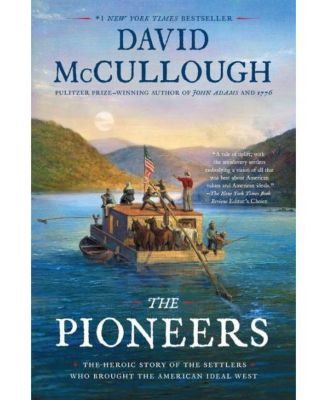
The #1 New York Times bestseller by Pulitzer Prize–winning historian David McCullough rediscovers an important chapter in the American story that's as resonant today as ever (The Wall Street Journal)—the settling of the Northwest Territory by courageous pioneers who overcame incredible hardships to build a community based on ideals that would define our country. As part of the Treaty of Paris, in which Great Britain recognized the new United States of America, Britain ceded the land that comprised the immense Northwest Territory, a wilderness empire northwest of the Ohio River containing the future states of Ohio, Indiana, Illinois, Michigan, and Wisconsin. A Massachusetts minister named Manasseh Cutler was instrumental in opening this vast territory to veterans of the Revolutionary War and their families for settlement. Included in the Northwest Ordinance were three remarkable conditions- freedom of religion, free universal education, and most importantly, the prohibition of slavery. In 1788 the first band of pioneers set out from New England for the Northwest Territory under the leadership of Revolutionary War veteran General Rufus Putnam. They settled in what is now Marietta on the banks of the Ohio River. McCullough tells the story through five major characters- Cutler and Putnam, Cutler's son Ephraim, and two other men, one a carpenter turned architect, and the other a physician.

Does The Past Have Hope For The Future?
The Pioneers is probably not one of David McCullough's major works, but I found it to be an interesting and encouraging book. It provided me with an antidote for the sordid saga of Donald Trump's summer 2023 indictments and left me with at least some hope for the future. The Pioneers was not a big picture story. Instead it was probably nearer to what is called micro-history. McCullough told the story of a group of New England settlers who moved to what is now Ohio in search of land and/or employment. What made them special was their patriotism, not the MAGA jingoism so many espouse today, but the concept of working together for the greater good. McCullough did allude to larger events such as conflicts with the local tribes and the dispute over slavery. One parallel with today was the brief appearance of Aaron Burr, who like Trump put his own ambition above the good of the country. What gave me hope was reading of ordinary people who believed in working together and respected each other, learning, and science. Are there still enough of them around to keep the American dream alive? We shall see. Four stars.
Recommends this product
Customer review from barnesandnoble.com